Why I Do This Work


By Aakash Sharma | April 26, 2026
The first immigration case
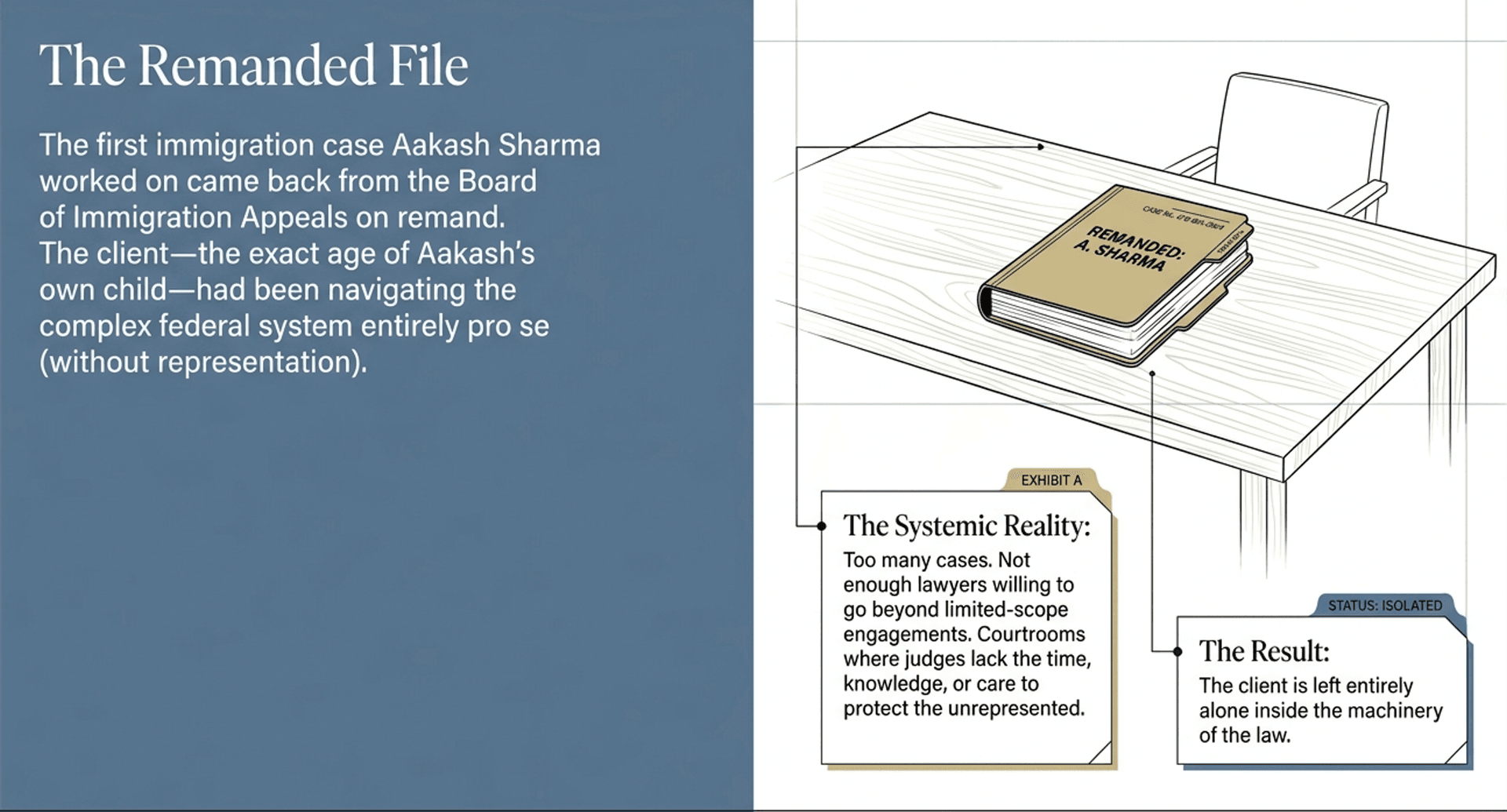
I worked on came back from the Board of Immigration Appeals on remand to the immigration judge. The client had been navigating it pro se. He was the age of my kid.
I sat with the file and realized something that has shaped how I practice ever since: the system was not going to take care of this person. There were too many cases and not enough lawyers willing to go past the edge of a limited-scope engagement. Judges, in some courtrooms, did not seem to know the law and, to be honest, did not seem to care. The client in front of me was alone inside all of that.
So I made a quiet promise. One live case at a time. Take it on. Don't leave until it closes — and do everything I can to close it well.
That is the operating commitment behind everything that follows.
He was the age of my kid.
I was drawn to immigration law for two reasons, and I'll name both.
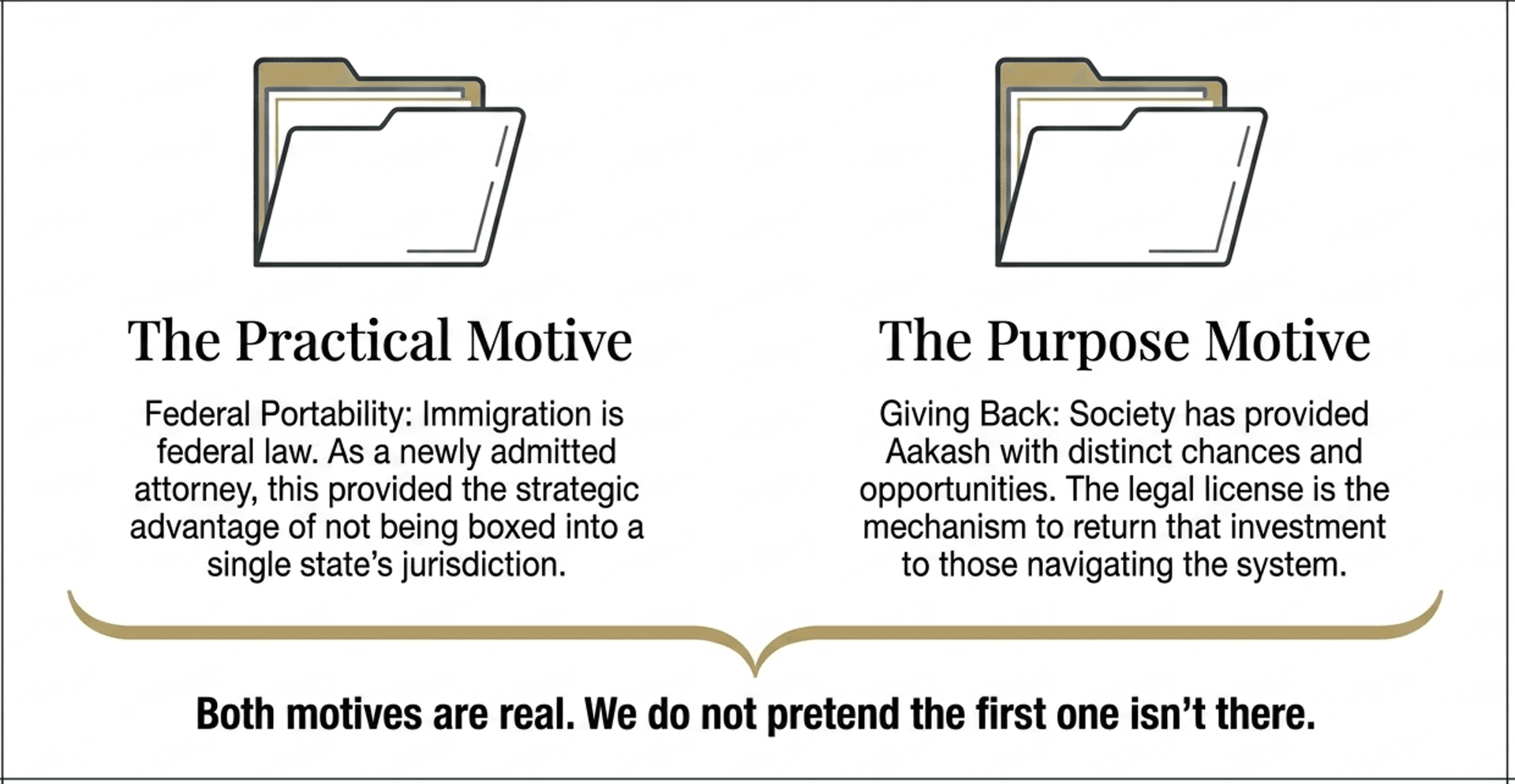
The first is practical. It is federal law. As a newly admitted attorney, federal practice meant I was not boxed into a single state. The portability mattered to me.
The second is the help angle, and it is also true. I have been given chances by this society. The license is one way I give some back.
Both motives are real. I am not going to pretend the first one wasn't there.
I also do not run this practice as my livelihood. I have a 20-plus-year career in enterprise technology, and that career is what pays the bills. I built the immigration practice deliberately as a focused, capacity-constrained solo practice on top of that. The day job is the reason this practice can be what it is. I can say no to cases I shouldn't take. I can spend the time a case actually needs. I do not need any single client to become my next paycheck. That is not a side note to how I practice. It is the structural fact that makes the rest of how I practice possible.
In the asylum blog I published earlier this year, I wrote a sentence I meant: in asylum work, attention to detail is not a professional virtue. It is a moral obligation. I want to show what that looks like on a real day.
In one matter, the file ran to roughly a thousand pages. A mentor on the case had told me, in passing, that the client knew a particular version of English. I was using AI tools to help me move through the volume, and I let that assumption settle into the workproduct headed toward the judge. When I finally sat with the client directly, he corrected me. He spoke a different version of English. The distinction mattered. The brief, as drafted, was wrong about him in a way that would carry into how the court understood him.
The AI could not catch it.
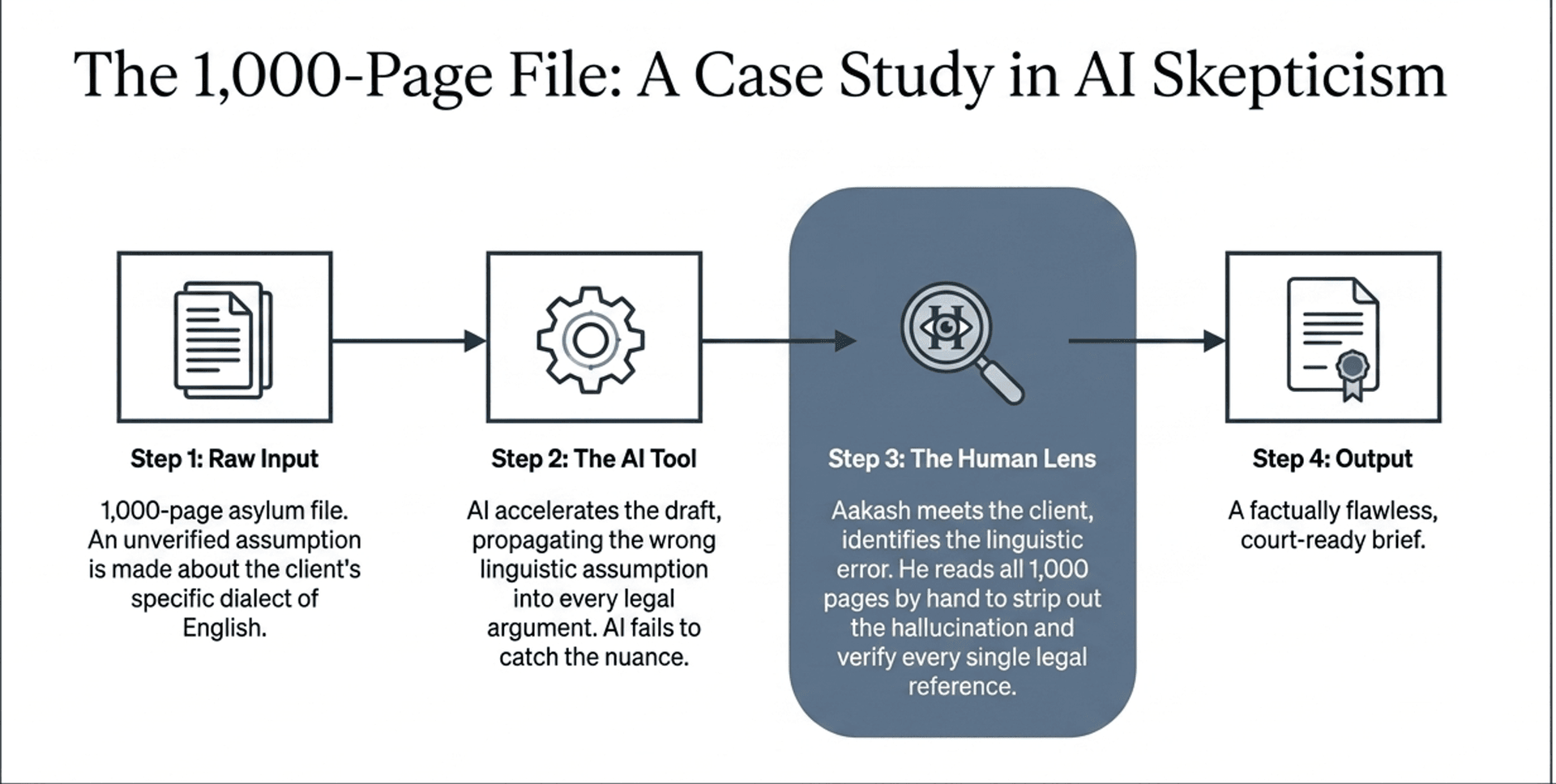
I had told it the wrong thing. Once that assumption was in, every subsequent draft carried it forward.
I read all thousand pages. By hand. I caught the assumption everywhere it had propagated, and I corrected it. I also checked every legal reference the AI had produced, because by then I knew not to take any of them on trust.
That is the rule I now follow on every matter where AI helps me move faster. Read it through. Verify every reference. Catch the hallucinations yourself. AI is a tool I use seriously and skeptically. It does not replace the read.
Doing the actual work, not the appearance of it, is sometimes a thousand-page afternoon.
When someone reaches out, I run the matter in two phases. Phase 1 is preliminary work — background, document review, the structural questions about whether the legal elements of the case can actually be met. If something disqualifying surfaces in Phase 1, I stop. I tell the client why. I refund whatever is left of the retainer after Phase 1 costs. We do not move into Phase 2.
This is built into how I take on work, and I tell clients about it in the first conversation, not after we've started.
When I decline a case, I tell the prospective client the reason and I tell them to get a second opinion. Especially in asylum. Taking on a weak asylum case creates wrong hope, and wrong hope is expensive twice — once in money, and again in the worse outcome that comes when a case fails for reasons that were visible at the start. I will not put a client through that to keep the engagement.
Wrong hope is expensive twice — once in money, and again in the worse outcome.
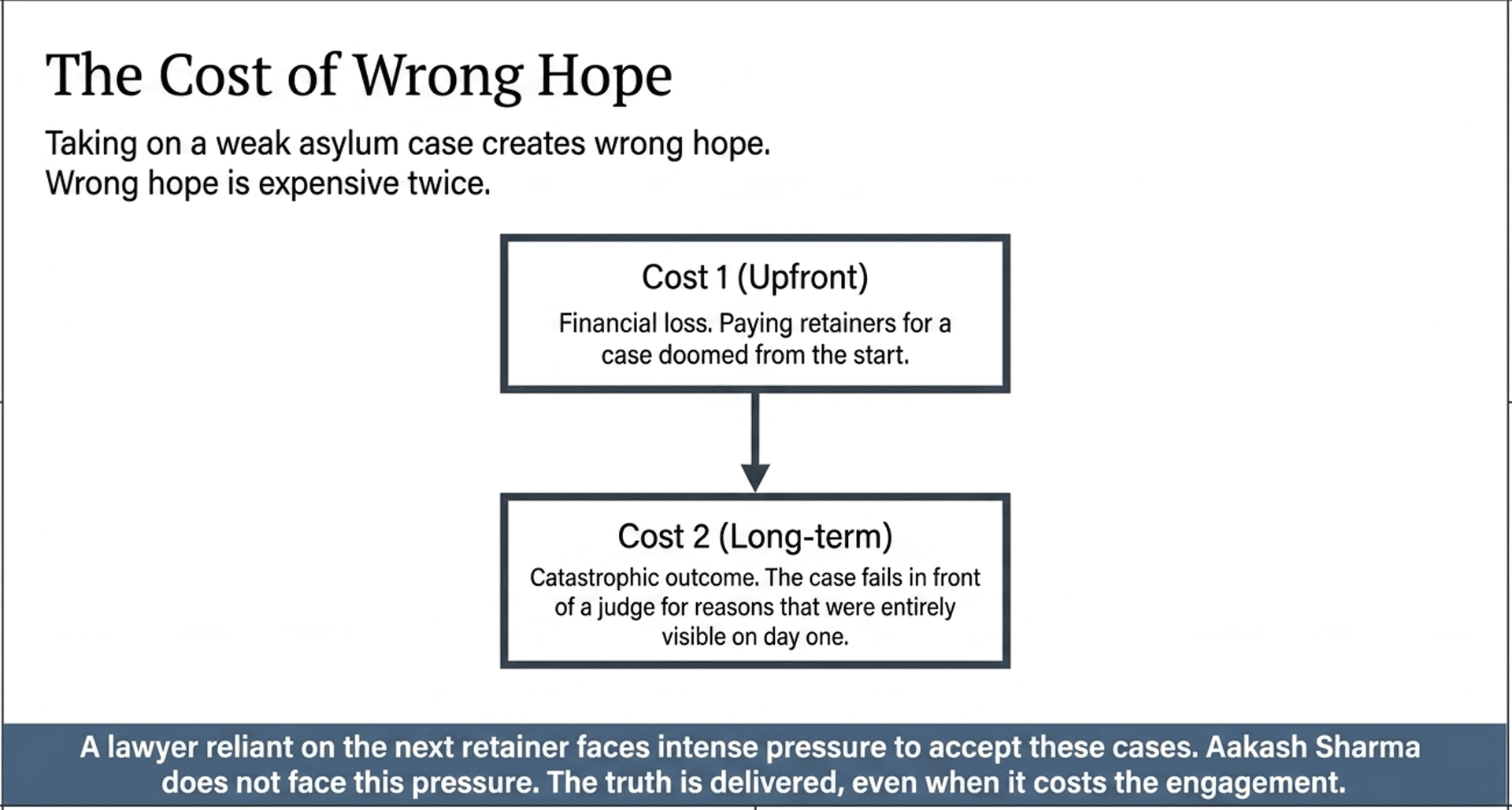
This is where the parallel career earns its place again. A lawyer whose mortgage depends on the next retainer faces real pressure to take cases that should not be taken. I do not face that pressure. I can tell a prospective client the truth about their case, including when the truth is that I am not the right person, and I can do it without weighing it against my own bills. Most of the things I do differently in this practice trace back to that fact.
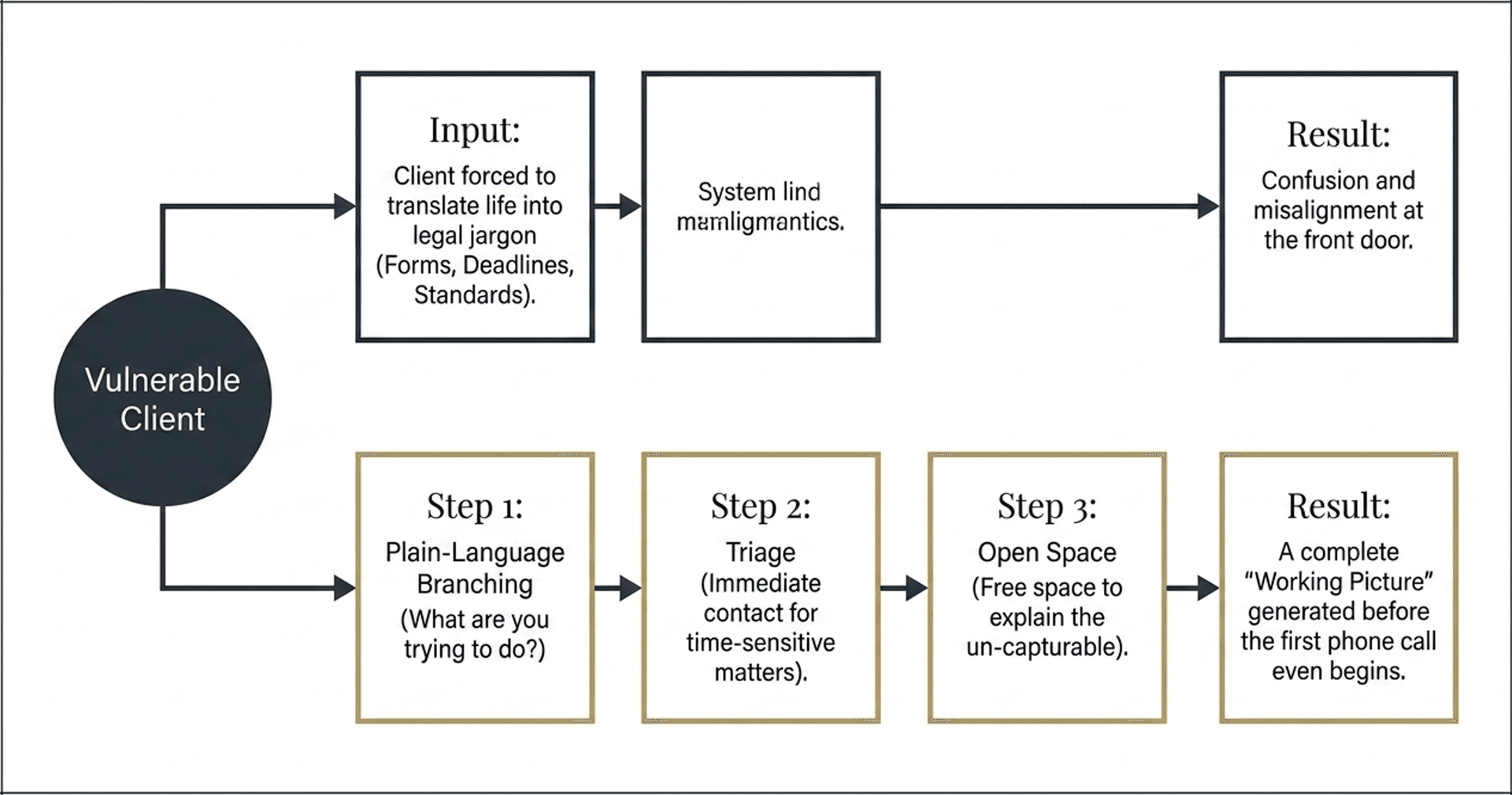
Most clients who reach out are not in a position to frame their situation as a legal problem. They know what happened to them. They do not know which form, which deadline, which category, which standard. Asking them to translate their life into legal vocabulary at the front door is the wrong place to start.
So my intake doesn't ask them to. It is built around plain-language branching questions — what are you trying to do, has this happened, is there a court date coming up — with an immediate-contact path for anything time-sensitive and a free space at the end for the client to tell me anything the form did not capture. By the time we get on a call together, I already have a working picture. The free consultation is not the place where I learn what the client needs. It is the place where I tell them what I see and whether I think I can help.
That changes what the first conversation is about. It is not strategy. It is clarity. Am I in the right place. Does this lawyer understand what is happening to me. Does he know enough to be useful. Is there a path here, and if not, what should I do instead.
Clarity is what I owe a prospective client before anything else.
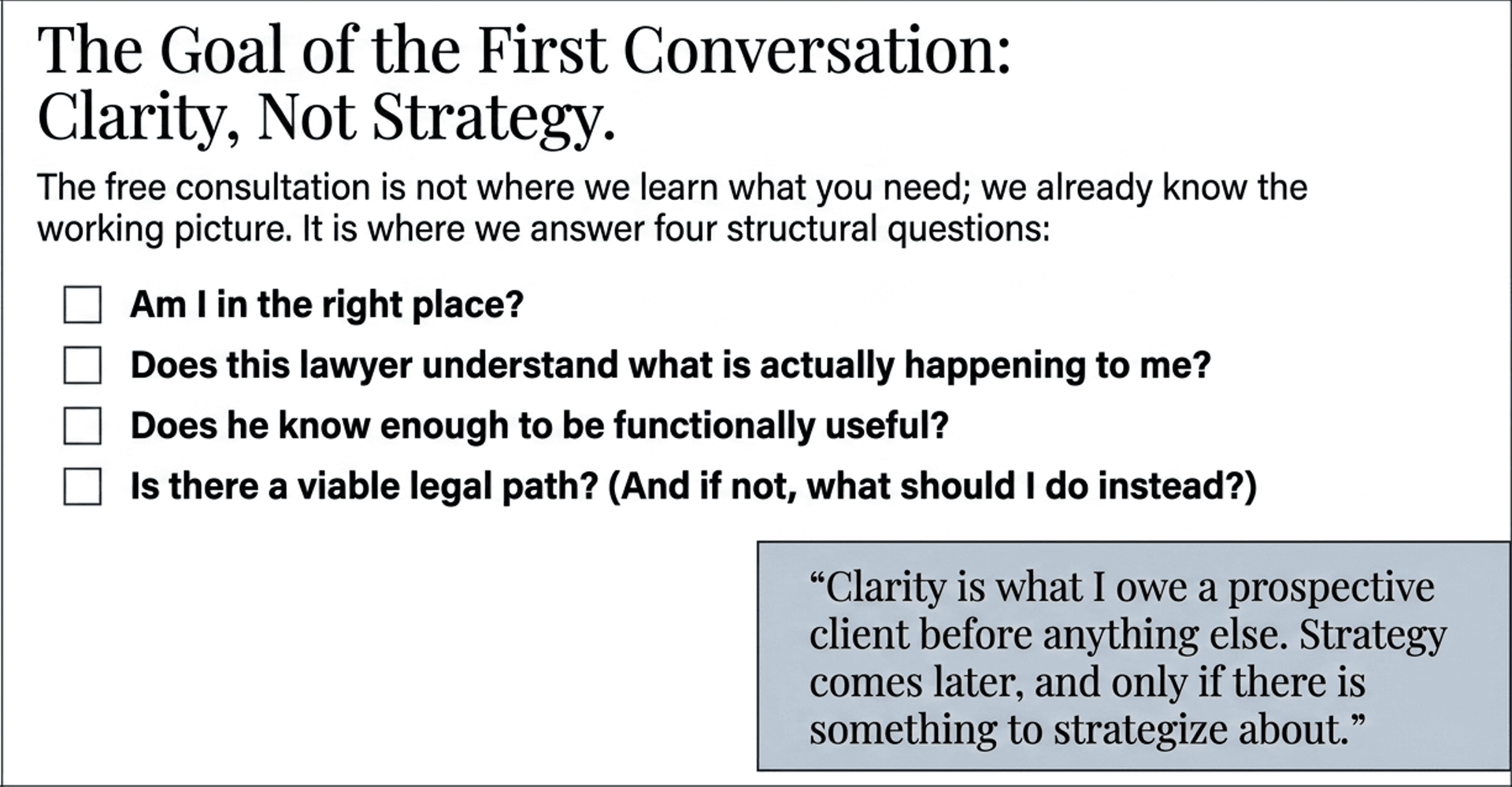
The strategy comes later, and only if there is something to strategize about.
The promise I made over that remanded file has not changed.
Every person who appears before an immigration judge deserves a lawyer who will tell them the truth about their case — including when the truth costs the lawyer the engagement — and who will then do the actual work, not the appearance of it. The afternoon spent reading every page. The reference checked instead of trusted. The refund returned when Phase 1 makes the answer clear. The second opinion recommended when I am not the right person.
That is what I am trying to be, on the cases I take.
That is why I do this work.
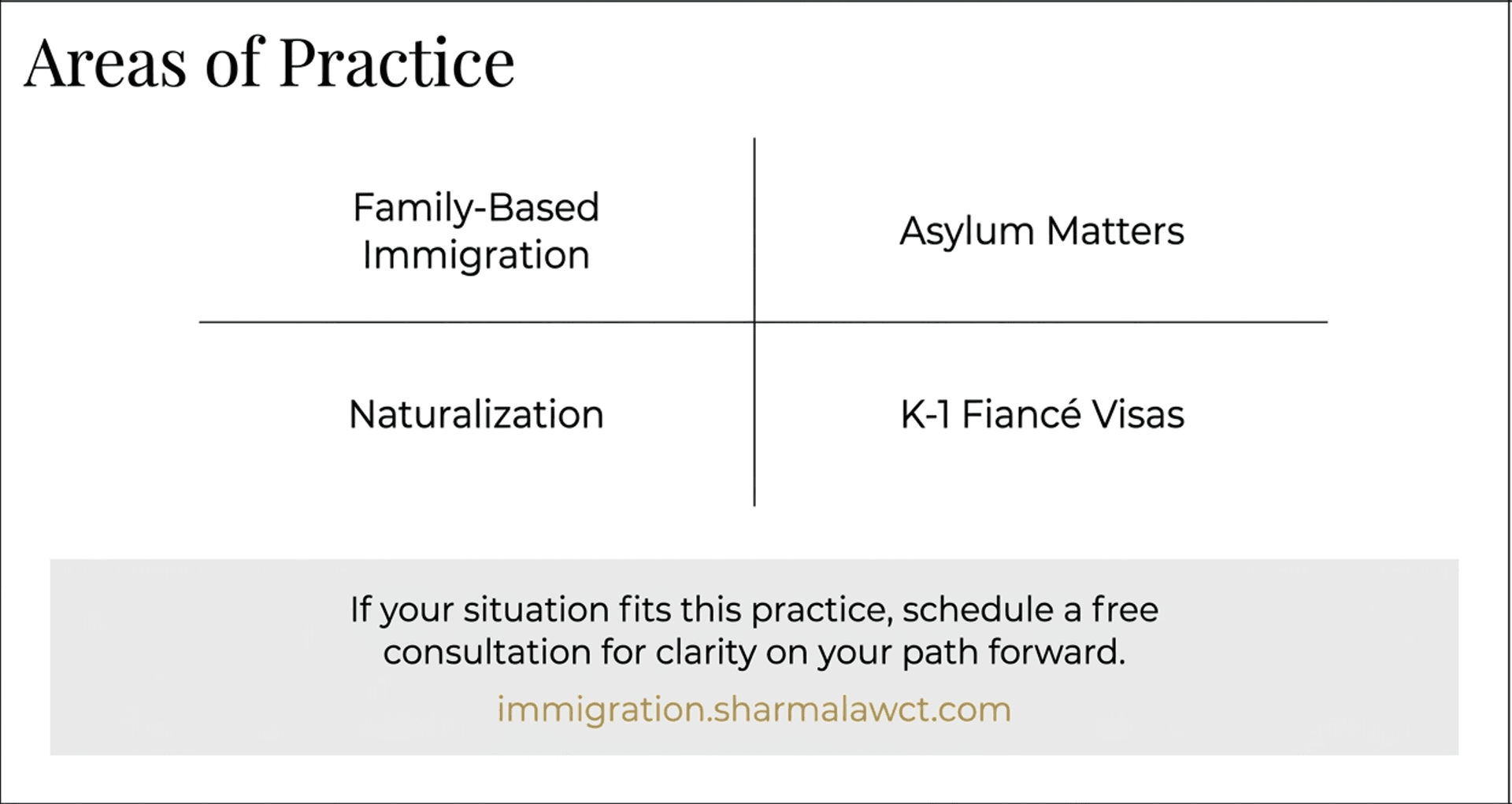
If your situation might fit this practice — family-based immigration, asylum, naturalization, or a K-1 fiancé visa — schedule a free consultation: immigration.sharmalawct.com
Aakash Sharma is a Connecticut-licensed attorney. His immigration practice handles family-based matters, asylum, naturalization, and K-1 fiancé visas.